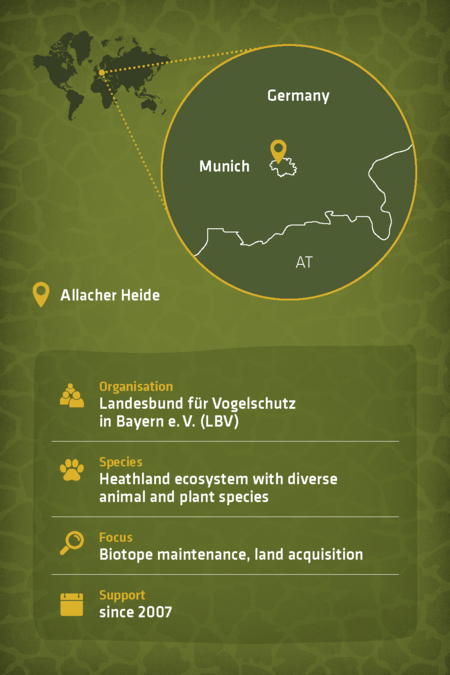
The LBV Munich (Bavarian Society for the Protection of Birds and Nature) is committed to the conservation of species and biotopes in the greater Munich area. The society is not only involved in in-situ conservation, but also aims to arouse enthusiasm for conservation through environmental education. Hellabrunn Zoo regularly offers financial support to the LBV Munich to protect the Allacher Heide heathland.
Biodiversity conservation on the outskirts of the city
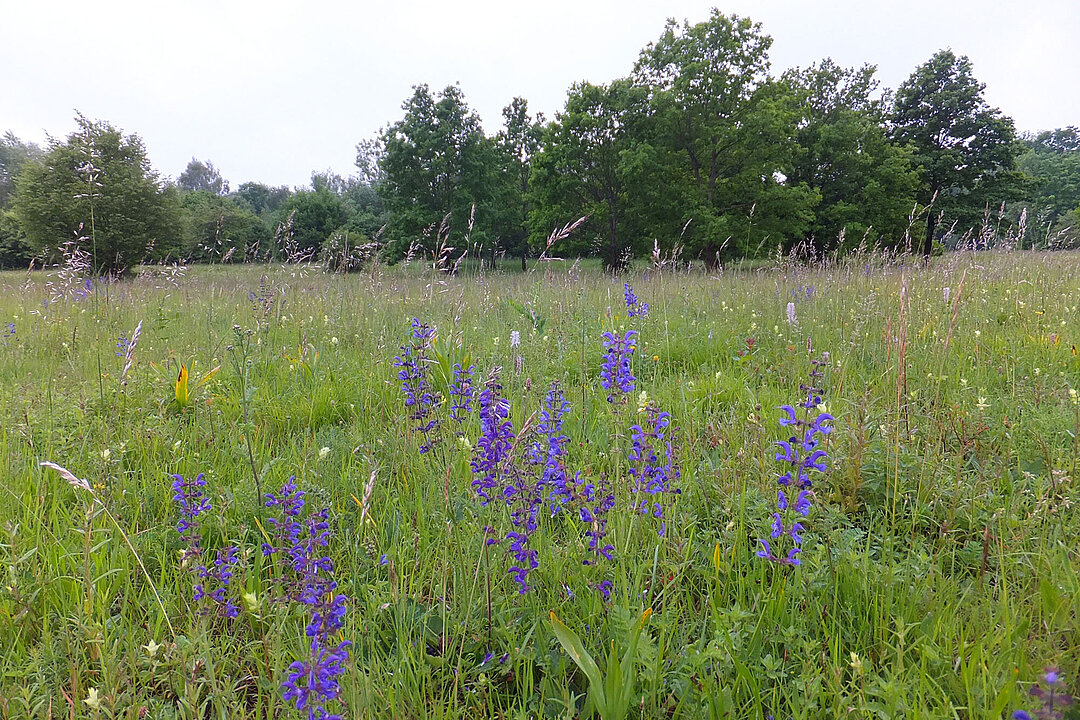
An important biodiversity hotspot is located right here in Munich! The Allacher Heide is a beautiful heathland situated near the München Nord Rangierbahnhof (Munich North marshalling yard). Now a relatively small remnant of what was once a much larger heath complex in north Munich, it offers a protected habitat for typical Munich heath species. The LBV has been maintaining the open landscape since 2004, with the help of many local volunteers, according to a concept that meets the needs of the local flora and fauna.
How can we protect the heathland?
This is not an easy question to answer. If left undisturbed, the heathland would revert to woodland over time. Centuries ago, large grazers such as aurochs and bison kept the heathland free of overgrowth. Later hardy livestock such as sheep and goats took over the role. Today, this job is done by the LBV. Having the right mix of landscape maintenance and "let it grow wild" is important. Hence, certain areas are mowed to avoid a litter layer (dead grass and flowers that prevents new plants from growing). Invasive species, such as Turkish rocket (Buniasorientalis), which competes with many native species, are also removed from the ecosystem in this way.
Rare species
The heathland is regularly mapped by experts, which means that every square metre is examined every 2-3 years for species occurrence. This allows the LBV to determine whether the maintenance measures are beneficial and whether there are still areas that need attention. The Allacher Heide is home to variety of rare species, such as the blue-winged grasshopper (Oedipoda caerulescens), which is highly endangered in Bavaria, but regularly found on the heath. The Idas blue (Plebejus idas), a regionally endangered butterfly, also occurs here. The Allacher Heide also has a large number of clover species and ants, which are essential to the survival of the butterflies.