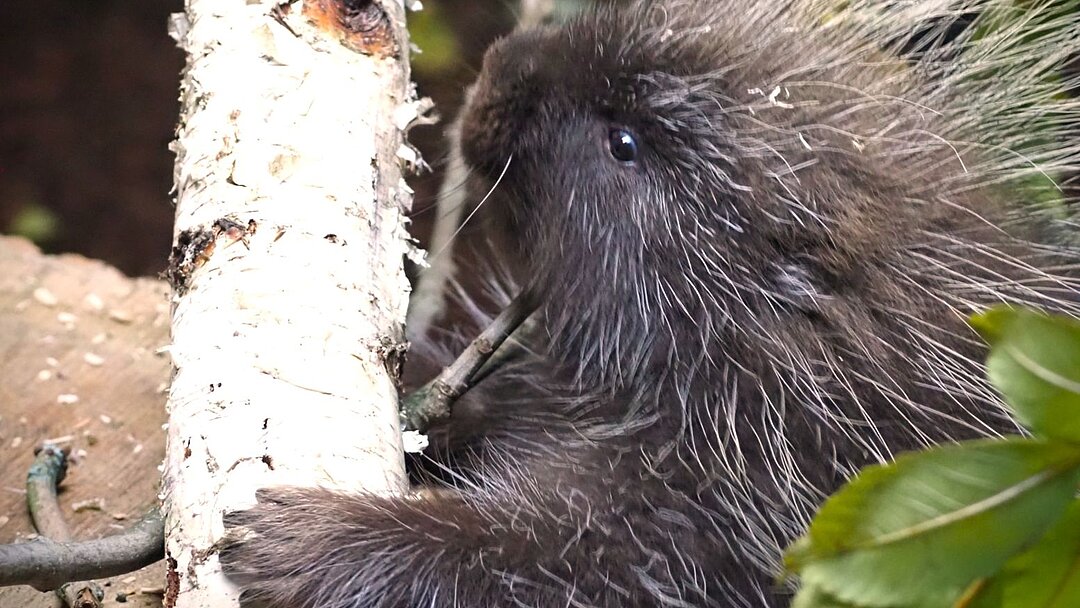
There is now a new species to discover at Hellabrunn Polarwelt: a female North American porcupine, also known as an ‘Urson’, has moved into the former arctic fox enclosure. The enclosure has been redesigned for the new residents and adapted to their needs. A male is due to join her shortly.
“North American porcupines are fascinating animals that are characterised by their remarkable adaptability. Their wide range across North America demonstrates just how well they cope with different habitats and climatic conditions. We are delighted to be able to introduce our visitors to this exciting species at Hellabrunn in future,” says Dr Eric Diener, zoological curator and head of the Polar World section.
North American porcupines belong to the rodent family and are best known for their spiny coat and climbing skills. Around 30,000 barbed spines protect the animals from predators. When in danger, the spines can easily detach and become lodged in an attacker’s skin.
Although North American porcupines are rather slow-moving, they navigate trees and shrubs with great agility. Their strong claws provide them with a secure grip. Their diet includes, amongst other things, leaves, buds, bark and fruit. The range of the North American porcupine extends across large parts of North America and reaches as far as Hudson Bay in Canada – a region where polar bears are also found. Their ability to adapt to different habitats and climatic conditions makes these animals particularly interesting.
The female is currently still settling into her new home and may therefore not always be visible in the outdoor enclosure. A male is due to join her in a few weeks’ time. If the animals get on well and the conditions are right, offspring may well be on the cards in the future. The animals at Hellabrunn were born in 2026. North American porcupines do not reach sexual maturity until they are about two years old, so it will be some time yet before they have offspring.
Translated by deepl / AI